
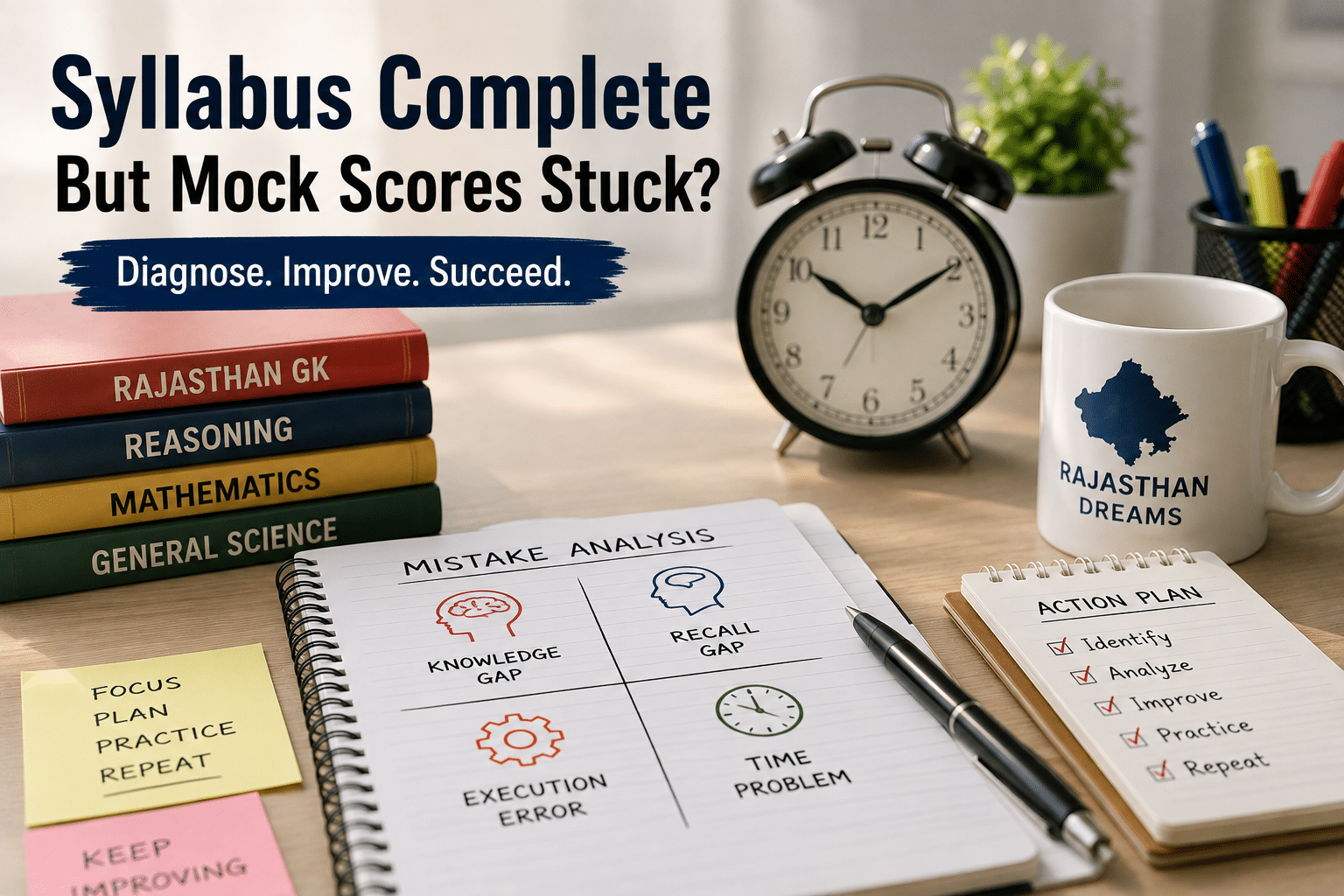
Finishing the syllabus feels like an important milestone in competitive-exam preparation.
You have covered Rajasthan GK, reasoning, mathematics, language sections and other subjects required for your target examination. You begin taking mock tests expecting your score to improve steadily.
But after several tests, something confusing happens.
The score barely moves.
The natural reaction is often:
“I need to study more.”
Sometimes you do. But sometimes more study is not the solution because unfinished knowledge isn’t the main problem anymore.
Your mock test is giving you diagnostic information. Instead of looking only at the final score, examine why you lost each mark.
A practical way to do that is to classify your mistakes into four categories.
Your Mock Score Is an Output, Not a Diagnosis
Suppose you score 62 in one mock test and 64 in another.
Those numbers tell you the result, but very little about the underlying problem.
Two students can both score 62 for completely different reasons.
One may not know enough concepts.
Another may know the material but lose marks through rushed calculations, forgotten facts and poor time allocation.
Giving both students the same advice—“study harder”—wouldn’t address their individual weaknesses.
After every serious mock test, classify your incorrect or unattempted questions as:
Knowledge Gap → Recall Gap → Execution Error → Time Problem
This turns a score into actionable feedback.
Problem 1: You Never Properly Learned the Concept
This is the most straightforward category.
You read a question and realize:
“I genuinely don’t know this.”
Perhaps that part of the syllabus was skipped. Maybe you studied it superficially. Or you memorized a formula without understanding when to apply it.
Mark these questions as Knowledge Gap.
Your response should be targeted learning rather than immediately taking another mock.
Go back to the relevant syllabus topic, understand the concept, solve a few appropriate practice questions and then retest yourself.
Most importantly, don’t reopen the entire subject because of five weak topics.
Identify those five topics.
A mock test should make your next study session more specific, not broader.
Problem 2: You Studied It, but Couldn’t Recall It
This feels different.
When you see the correct answer afterward, you immediately think:
“I knew that!”
This may happen with Rajasthan GK facts, formulas, vocabulary, definitions or other information that requires retrieval.
The issue may not be first-time learning. It may be recall strength.
Simply rereading the same chapter repeatedly can create familiarity without ensuring that you can retrieve the information during a test.
Try a different revision method.
Close your notes and answer questions from memory.
Use:
- Short self-tests
- Flashcards where suitable
- Blank-page recall
- Maps for geographical information
- Timelines for historical information
- Formula recall before solving problems
The goal is to practise bringing information out of memory, not only putting information in.
Problem 3: You Knew the Answer but Executed It Incorrectly
This category deserves much more attention than it usually receives.
Examples include:
- Reading “incorrect” as “correct”
- Copying a number incorrectly
- Making an arithmetic mistake
- Selecting the wrong option despite solving correctly
- Missing a condition in the question
- Changing a correct answer without a clear reason
These aren’t necessarily knowledge failures.
They are execution errors.
Imagine spending three hours revising mathematics when the real reason you lost marks was repeatedly rushing through calculations.
More theory may not fix that.
Instead, record the specific behavior that caused the mistake.
Don’t write:
“Silly mistake.”
Write:
“Didn’t check the sign before calculation.”
or:
“Answered before reading all four options.”
Specific mistakes can be corrected. “Carelessness” is too vague to train against.
Problem 4: You Could Solve It — but Not Within the Available Time
Some questions become easy when you review them after the test.
During the mock, however, you either left them unanswered or spent too long on them.
That is a time-management problem.
It may indicate:
Slow calculation: you understand the method but need appropriate practice.
Poor question selection: you spend too long fighting one difficult question.
Slow recall: you know the fact but take too long to retrieve it.
Bad section strategy: too much time goes into one area, leaving insufficient time for another.
The solution depends on which of these is happening.
Simply telling yourself to “be faster” isn’t a strategy.
Build a Mock Test Error Ledger
Instead of maintaining only a notebook of scores, create an Error Ledger.
After every mock, record something like this:
| Question/Topic | Error Type | What Happened? | Next Action |
|---|---|---|---|
| Rajasthan Geography | Recall | Mixed up two facts | Map-based revision |
| Percentage | Execution | Calculation error | Slow down final step |
| Reasoning | Time | Spent too long | Practise question selection |
| History topic | Knowledge | Topic not prepared | Study concept |
| Language | Execution | Misread instruction | Highlight question command |
After several mocks, don’t focus first on your marks.
Count your error categories.
That may reveal something much more useful.
Find Your “Most Expensive” Mistake
Suppose your last four tests show:
Knowledge gaps: 6
Recall gaps: 17
Execution errors: 19
Time-related losses: 8
In this hypothetical example, starting a completely new GK book may not be the highest-priority response.
Execution and recall are causing more losses.
Your preparation should respond to the evidence.
Another student may discover that knowledge gaps dominate. That student needs a different plan.
This is why copying someone else’s revision strategy can be ineffective.
Your mock tests are producing your own performance data.
Use it.
Stop Taking Mocks Just to Collect Scores
Taking many mock tests can feel productive.
But a cycle like this has limited value:
Mock → Check score → Feel good/bad → Next mock
Replace it with:
Mock → Review → Classify → Repair → Retest
The repair stage is where improvement happens.
If a mock exposes weak percentages, revise and practise percentages.
If Rajasthan History recall is poor, test yourself on that area.
If you repeatedly run out of time, practise timed question sets.
Then your next mock becomes a test of whether the intervention worked.
Don’t Chase Accuracy Without Understanding the Exam Rules
Different examinations can have different marking schemes, question counts, time limits and negative-marking rules.
Your attempt strategy should therefore be based on the current official examination pattern, not a generic rule from another exam or an old social-media post.
Before deciding how aggressively to attempt questions, verify the relevant official notification or examination instructions.
This is especially important when guessing can carry a penalty.
Create a Personal “Do Not Repeat” List
After analysing several tests, you may notice recurring behaviours.
Turn them into a short list that you read before the next mock.
For example:
Read the complete question.
Don’t spend excessive time on one problem.
Recheck calculation signs.
Don’t change answers without a reason.
Your list should contain your recurring mistakes—not generic motivational advice.
Keep it short enough that you actually use it.
When Should You Take the Next Full Mock?
Not automatically tomorrow.
If your previous mock exposed significant weaknesses, spend some time repairing them first.
Otherwise, repeatedly testing the same weakness may simply reproduce the same score.
Full mocks are useful for measuring overall performance.
Smaller topic-wise or sectional tests can be better when you are trying to repair one particular weakness.
Use both for different purposes.
Final Takeaway
A stagnant mock-test score doesn’t automatically mean your preparation has failed.
It means you need better information about where your marks are going.
After your next Rajasthan competitive-exam mock, don’t begin with:
“How many marks did I score?”
Begin with:
“Why did I lose the marks I could realistically have scored?”
Separate those losses into:
Knowledge → Recall → Execution → Time
Then work on the largest problem first.
Completing the syllabus tells you that you have covered the material.
Analysing your mistakes tells you whether you can use that material effectively under exam conditions.
That second skill can become increasingly important as the examination approaches.
FAQs
Why are my mock-test scores not increasing after completing the syllabus?
Possible reasons include unresolved concept gaps, weak recall, execution mistakes, poor question selection or time-management issues. Analyse incorrect and unattempted questions before deciding what to study next.
Should I take a mock test every day?
There is no universal frequency. The useful frequency depends on your preparation stage and exam timeline. A mock provides more value when you also have enough time to review and correct the weaknesses it exposes.
Should I attempt more questions to increase my score?
Not automatically. Your strategy should consider accuracy, available time and the official marking scheme, including any applicable negative marking.
Is analysing a mock test as important as taking it?
Analysis can be extremely valuable because it identifies why marks were lost and what should be corrected before the next test.
Where should I check the current Rajasthan exam pattern?
Check the latest official notification, syllabus and instructions published by the authority conducting your specific examination. Exam rules can change, so current official information should take priority over older preparation material.