A new government recruitment notification appears online.
The headline says:
“Thousands of Vacancies — Apply Online Now.”
For many candidates, the first questions are predictable:
How many vacancies are there? What is the last date? What is the salary?
Those details matter, but they should not be your starting point.
A recruitment notification is more than an announcement. It contains the rules that determine who can apply, under what conditions, how selection works and what candidates must do during the process.
Reading only a social-media summary, YouTube thumbnail or third-party article can cause you to miss an important condition.
Before submitting an application for a Rajasthan or other government recruitment, develop a habit:
Read the official notification yourself.
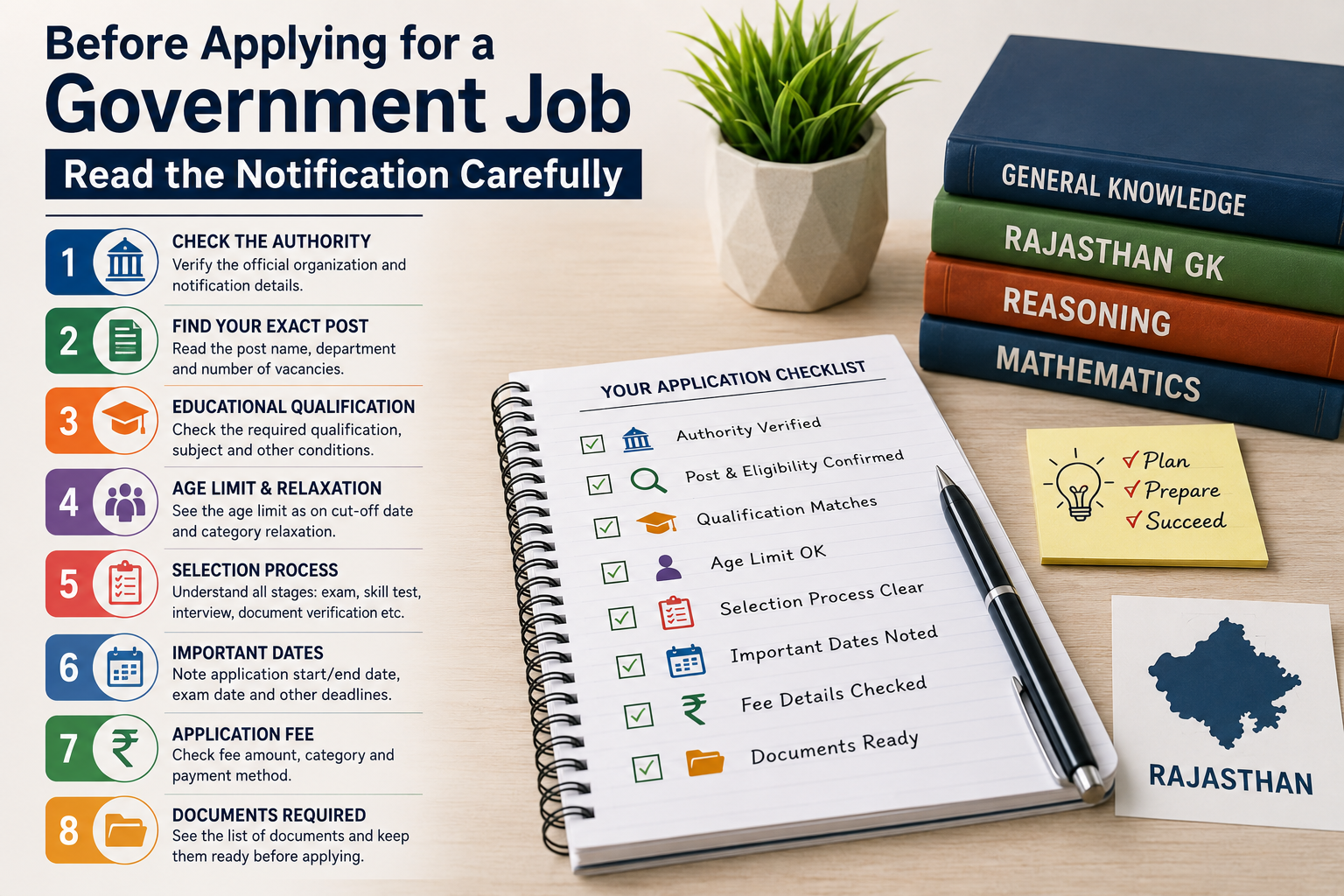
Here are eight areas worth checking carefully.
1. Start With the Recruiting Authority, Not the Vacancy Number
Before becoming interested in the number of posts, confirm who actually issued the recruitment.
Look for the official:
- Recruiting organization
- Advertisement/notification number
- Publication date
- Official website or recruitment portal
This simple check helps separate an actual recruitment notice from recycled, incomplete or misleading information circulating online.
Be particularly careful with messages forwarded through WhatsApp, Telegram or social media.
A professional-looking poster is not proof that a recruitment exists.
If you discover a vacancy through another website, use it as a starting point—but verify important information through the relevant official authority.
2. Find Your Exact Post
A single recruitment advertisement can contain several different posts.
The headline may say:
“2,000+ Government Vacancies”
but those vacancies might be distributed across multiple roles, categories, departments or locations.
You may be eligible for only one of them.
Instead of asking:
“How many total vacancies are available?”
ask:
“Which exact post am I eligible and interested in applying for?”
Then follow the rules for that specific post throughout the notification.
This prevents information from one post being accidentally applied to another.
3. Read Educational Qualification Word by Word
This is one of the most important sections.
Do not reduce qualification requirements to broad labels such as:
“Graduate required.”
The actual notification may specify a particular degree, subject, diploma, certification, technical qualification, institution requirement or another condition.
Also check the date by which the required qualification must be completed.
For example, being in the final year of a course and already possessing the required qualification may not always be treated the same way.
The exact rule depends on the recruitment.
Never assume eligibility simply because someone with a similar educational background applied previously.
Read the current notification.
4. Don’t Check Age Limit Without Checking the Cut-Off Date
Suppose a notification states an age range.
A candidate immediately calculates:
“I am 27, so I’m eligible.”
But age eligibility is generally determined with reference to a specified date or rule in the notification.
That reference matters.
Also examine any applicable provisions relating to:
- Minimum age
- Maximum age
- Category-based relaxation
- Other eligible relaxation categories
- Required supporting documents
Do not calculate age eligibility using today’s date unless the notification specifically requires that.
Use the date and conditions stated in the official advertisement.
If your eligibility depends on a relaxation, read that provision carefully rather than relying on a general age-limit chart from another recruitment.
5. Understand the Selection Journey Before You Apply
Candidates sometimes prepare only for a written examination because the advertisement headline says “Exam.”
But the complete selection process may involve multiple stages.
Depending on the recruitment, these could include stages such as:
Written Examination → Skill/Typing Test → Physical Test → Document Verification → Medical Examination
This is only an illustration. Actual stages vary by recruitment.
Why should you check this before applying?
Because a vacancy that looks suitable based only on qualification may include a later requirement you did not expect.
For example, certain roles may require typing proficiency, physical standards, technical skills or other conditions.
Knowing the complete process helps you decide whether the opportunity genuinely fits you.
6. Find the Real Application Timeline
Recruitment articles often highlight only:
Last Date: XX/XX/XXXX
But there may be several dates that matter.
Create a small recruitment calendar containing only dates confirmed in the official notice:
| Event | Official Date |
|---|---|
| Application opens | ______ |
| Application closes | ______ |
| Fee deadline | ______ |
| Correction window | ______ |
| Exam date | Check official update |
Not every recruitment will contain every event.
Do not fill missing dates using assumptions.
Also avoid deliberately waiting until the final hour to apply. Technical issues, payment problems or incorrect documents can make last-minute applications unnecessarily stressful.
7. Check the Fee and Payment Conditions Carefully
Never assume the application fee based on another exam.
Check:
Fee applicable to your category
Accepted payment methods
Payment deadline
Whether any processing charges apply
Rules concerning refund, where relevant
Most importantly, make payment only through the process specified by the legitimate recruitment portal.
Be cautious if an unofficial message asks you to transfer an “application fee” directly to a personal UPI ID, bank account or unknown payment link.
When money is involved, verifying the website becomes even more important.
8. Read the Document Requirements Before Filling the Form
Many candidates think about documents only after passing an examination.
That’s too late to discover that important information doesn’t match.
Before applying, compare key details across the documents relevant to the recruitment.
Pay attention to information such as:
Your name
Date of birth
Category details
Educational records
Photograph/signature requirements
Certificates required for claimed benefits or eligibility
If there is a discrepancy, don’t invent a correction while completing the form.
Check the recruitment instructions and follow the appropriate official process.
Document requirements vary, so use the specific notification rather than a generic document checklist as your final authority.
Create a One-Page “Recruitment Decision Sheet”
Before clicking Apply, summarize the opportunity for yourself.
Keep it simple:
Recruiting Authority: __________
Post: __________
Qualification: Eligible / Need to verify
Age: Eligible / Need to verify
Important Dates: __________
Selection Stages: __________
Fee: __________
Documents Ready: Yes / No
Official Notification Checked: Yes / No
If you cannot confidently complete one of these fields, return to the official notification.
This five-minute exercise can prevent much larger problems later.
What About Salary?
Salary is obviously important.
But recruitment advertisements can describe compensation using terms such as pay level, pay matrix, fixed remuneration, probationary pay or other structures.
Do not automatically convert a figure in a headline into expected monthly take-home salary.
If compensation matters to your decision, read the official pay provisions and understand exactly what the notification states.
Avoid relying on exaggerated salary thumbnails.
Treat Every Recruitment as a New Set of Rules
One of the easiest mistakes experienced aspirants make is thinking:
“I applied for a similar exam last year. I know the process.”
Previous experience is useful.
But recruitment rules can change.
A new cycle can have different:
- Dates
- Vacancies
- Eligibility conditions
- Fees
- Syllabus
- Selection stages
- Document requirements
- Application instructions
Use your previous experience to navigate the notification faster—not to skip reading it.
Final Takeaway
A government recruitment notification shouldn’t be treated like a poster announcing vacancies.
It is closer to an instruction manual for that particular recruitment.
Before you spend hours preparing, paying an application fee or uploading personal documents, verify the opportunity properly.
Remember this sequence:
Authority → Post → Qualification → Age → Selection → Dates → Fee → Documents
And one final rule is worth keeping:
Discover anywhere. Verify officially. Apply carefully.
A few extra minutes spent reading the correct notification can be more valuable than rushing to submit an application based only on a headline.
FAQs
Is information from job websites enough to apply for Rajasthan government recruitment?
Third-party websites can help you discover opportunities, but important details such as eligibility, dates, fees and selection rules should be verified through the relevant official notification or recruitment authority.
Should I apply if I am not sure about my educational eligibility?
Check the exact qualification wording in the official notification first. If the requirement remains unclear, use official clarification/contact channels where available rather than guessing.
Why is the age cut-off date important?
Because eligibility may be calculated with reference to a particular date specified in the notification. Your age today alone may not determine eligibility.
Can government recruitment rules change from the previous year?
Yes. Recruitment conditions can differ between cycles. Always check the current notification even if you previously applied for a similar post.
What should I check before paying an application fee?
Confirm that you are using the legitimate application portal, verify the fee applicable to you, and follow the payment method and deadline stated in the official recruitment instructions.