
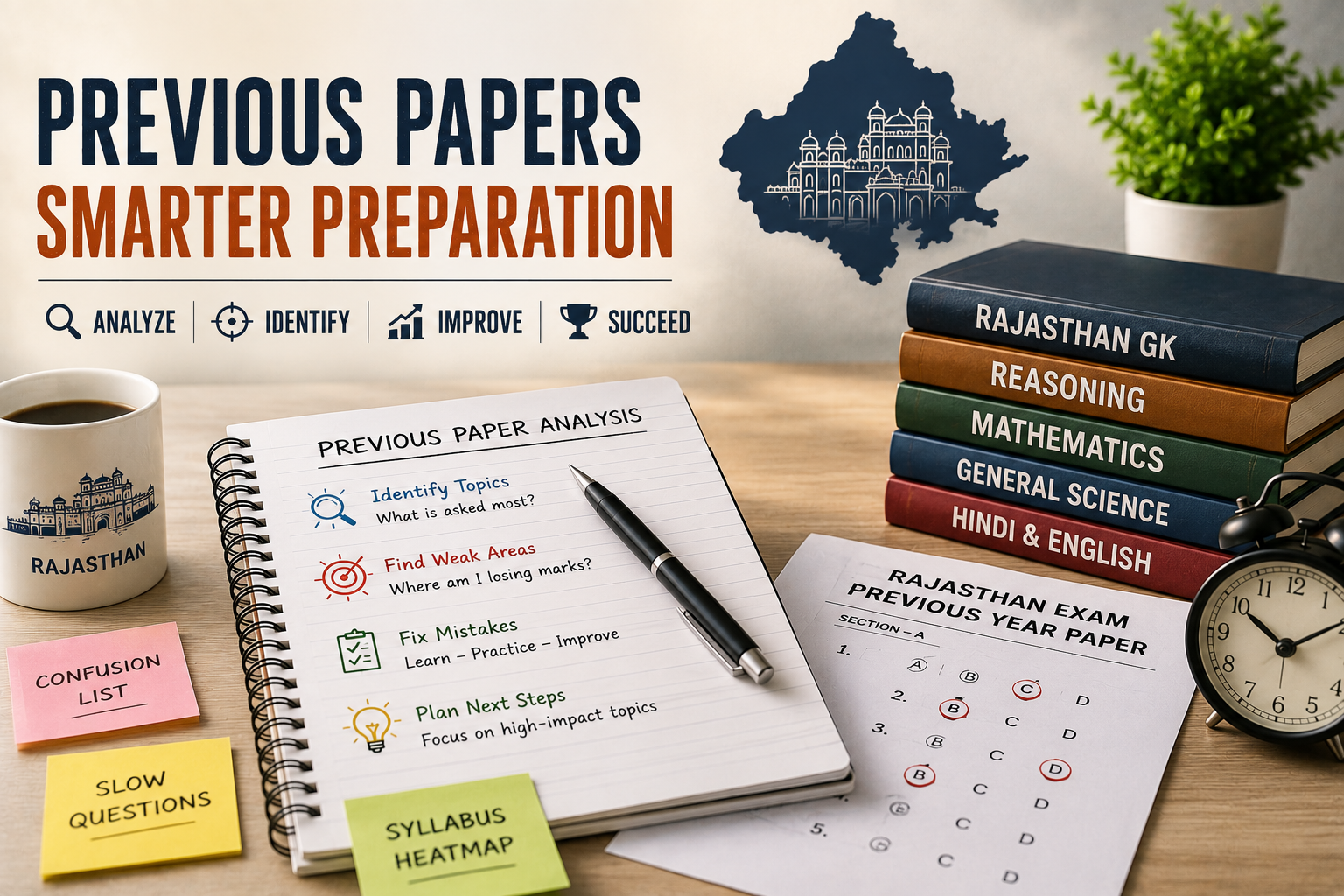
A previous year question paper is often treated like a final test.
You set a timer, answer the questions, calculate your score and check how many answers were correct.
Useful? Yes.
But that uses only a small part of what an old paper can tell you.
For a Rajasthan competitive-exam aspirant, a relevant previous paper can also reveal how the syllabus turns into actual questions.
It can show where your preparation is too shallow, which topics take too long, where similar options confuse you and which parts of your notes aren’t helping you answer questions.
The key is to stop treating every previous paper as something you simply solve and forget.
Instead, turn it into a map for your next round of preparation.
First, Don’t Open Your Notes
Choose a previous paper relevant to the examination you are preparing for.
Before solving it, avoid quickly revising every chapter just to improve your score.
Why?
Because you want the paper to expose what you can actually retrieve from your existing preparation.
Attempt it under reasonably realistic conditions wherever possible.
Then, before checking solutions, mark each question with one of three symbols:
✓ — Confident
? — Answered, but uncertain
— — Could not answer
This creates something your final score cannot provide:
a confidence map.
Sometimes your most important weakness isn’t an incorrect answer.
It’s a correct answer that was mostly a guess.
The Questions You Got Right Still Need Analysis
Students naturally spend most of their review time on wrong answers.
But look carefully at your correct answers too.
Suppose you answered 70 questions correctly.
How many were:
Known confidently?
Solved logically?
Narrowed down to two options and guessed?
Remembered vaguely?
Two correct answers can represent very different levels of preparation.
A lucky answer increases today’s score.
It doesn’t necessarily increase your readiness for the next paper.
Mark uncertain correct answers separately and revisit their underlying concepts.
Turn the Paper Into a Syllabus Heatmap
Now take the official syllabus and place the paper beside it.
Don’t begin by counting how many times a specific exact question appeared.
Instead, identify the topic behind each question.
For example:
Question → Rajasthan Geography → Rivers
Question → Mathematics → Percentage
Question → Reasoning → Series
Question → General Science → Biology
Continue through the paper.
Afterward, your syllabus starts looking less like a long document and more like a collection of topics that have appeared in real examination conditions.
However, be careful with the conclusion.
If a topic appeared frequently in one previous paper, that does not guarantee the same weight in a future examination.
Past papers are evidence of previous patterns—not a prediction machine.
Now Perform the “Depth Check”
Here’s where previous papers become especially useful.
For every question you struggled with, ask:
Did my study material actually prepare me to answer this?
Suppose your notes contain:
“Read Rajasthan rivers.”
But the question requires you to distinguish between locations, characteristics or related facts.
That tells you something important.
The chapter may technically be “completed,” but your knowledge isn’t deep enough for the way questions can be framed.
Write beside the topic:
Need more depth
or
Current notes sufficient
or
Need more practice
You are now evaluating your resources rather than blindly collecting more of them.
Identify “Confusion Pairs”
Competitive exams often become difficult when multiple options look familiar.
While reviewing a paper, write down the options you repeatedly confuse.
For example, you might mix up:
two similar historical names
two geographical locations
two constitutional terms
two formulas
two scientific concepts
Don’t simply memorize the correct option.
Create a tiny comparison.
| I Confuse | Difference I Need to Remember |
|---|---|
| Concept A vs Concept B | Key distinction |
| Place A vs Place B | Location/context |
| Formula A vs Formula B | When each applies |
Over time, this becomes your Confusion List.
It can be far more personal and useful than another 100-page generic PDF because it contains exactly the distinctions you struggle with.
Find Your “Slow but Solvable” Questions
Some questions aren’t difficult for you.
They’re just slow.
That’s a different problem.
While reviewing the paper, identify questions where:
- You eventually found the correct answer
- You understood the concept
- But you spent disproportionate time solving it
Label them:
SLOW
Now investigate why.
Did the calculation take too many steps?
Did you reread the question several times?
Did you forget the direct method?
Did you struggle to decide between options?
This creates a list of areas where you may not need more theory—you may need fluency.
Repeated appropriate practice can help make familiar processes more efficient.
Search Your Notes for “Dead Information”
Here is an unusual but useful exercise.
Take several important questions from the previous paper and try to find their concepts in your existing notes.
You may discover:
The information exists, but it’s buried inside long paragraphs.
That makes the notes difficult to revise.
Instead of rewriting the entire notebook, improve only the weak sections.
Turn buried information into:
- A short table
- A map
- A formula card
- A timeline
- A one-line distinction
- A small diagram
Your notes should evolve because of the questions you encounter.
This is how previous papers can improve your study material itself.
Create a 7-Day Response Plan
After analysing a paper, don’t immediately jump to another full paper.
Use what you discovered.
For example:
Day 1: Repair weak Rajasthan GK concepts
Day 2: Practise slow mathematics areas
Day 3: Review confusion pairs
Day 4: Strengthen weak reasoning concepts
Day 5: Active recall from updated notes
Day 6: Mixed practice questions
Day 7: Retest selected weak areas
This is only an example.
Your plan should come from your paper analysis, not from someone else’s timetable.
Notice the difference:
The previous paper is no longer the end of your study session.
It becomes the starting point for the next one.
Don’t Build Your Preparation Around “Most Repeated Questions”
Searching for repeated topics can be useful for understanding previous patterns.
But there’s an important boundary.
A previous paper cannot reliably tell you exactly what will appear in the next examination.
Avoid conclusions such as:
“This question appeared three times, so it will definitely come again.”
Exam authorities can change question distribution, difficulty, patterns or emphasis.
Your primary boundary should remain the current official syllabus and examination scheme.
Previous papers help you understand that syllabus.
They shouldn’t replace it.
The Three Documents Worth Keeping
After analysing several papers, you don’t need hundreds of screenshots.
Maintain three compact resources:
Confusion List — concepts and facts you mix up.
Slow List — questions/topics you understand but cannot handle efficiently.
Syllabus Heatmap — areas you’ve encountered and areas that still need attention.
These documents gradually become personalized to your preparation.
That’s something a generic study guide cannot provide.
Final Takeaway
Don’t ask only:
“How many previous year papers have I solved?”
A better question is:
“What changed in my preparation after I solved them?”
A useful previous-paper session should leave behind something:
a corrected concept, a stronger note, a discovered weakness, a confusion pair, a speed problem or a better revision priority.
Use the sequence:
Attempt → Mark Confidence → Map Topics → Investigate → Update → Practise
The paper has already been used once by the candidates who originally appeared for that examination.
Your advantage comes from using it a second way:
as evidence for deciding what you should study next.
FAQs
How many previous year papers should I solve for a Rajasthan competitive exam?
There is no universal number. Use relevant available papers based on your exam, preparation stage and time. Quality of analysis can matter more than simply increasing the number solved.
Can previous papers predict questions in the next exam?
No. They can reveal previous question styles and patterns, but they cannot guarantee future questions.
Should I solve previous papers before completing the syllabus?
They can still be useful for understanding question style and identifying important learning requirements. How extensively you attempt them depends on your preparation stage.
Should I memorize answers from previous papers?
Understanding the concept behind the question is generally more useful than memorizing an isolated answer, particularly if the same concept is asked differently later.
What should I verify before using an old Rajasthan exam paper?
Confirm that the paper actually belongs to the relevant examination and understand whether the current syllabus or exam pattern has changed. For current requirements, rely on the latest information from the official conducting authority.