The exam ends. You leave the examination centre, discuss a few questions with friends and finally feel that months of preparation are over.
Then, a few days or weeks later, another Rajasthan recruitment opportunity catches your attention.
A common reaction is:
“Now I need to start preparing again.”
But do you really need to start from zero?
Probably not.
Your previous preparation has already created something valuable: knowledge, notes, solved questions, exam experience and an understanding of your own strengths and weaknesses.
The problem is that many aspirants don’t preserve these assets properly.
Books are closed. PDFs disappear into phone folders. Current-affairs notes become outdated. Mistakes from the previous exam are forgotten.
Then the next recruitment arrives—and preparation feels new again.
A better approach is to build a reusable preparation system.
Your Exam Ends, but Your Preparation Should Leave Assets Behind
Think about what remains after an examination.
You may already have:
- Rajasthan GK notes
- History and Geography summaries
- Mathematics formulas
- Reasoning methods
- Language rules
- Computer fundamentals
- Practice questions
- Previous-paper analysis
- A list of mistakes
- Experience managing exam time
Not everything will apply to the next examination.
But some of it might.
Your first task after an exam shouldn’t be immediately buying another course or downloading another collection of PDFs.
It should be identifying:
What from my previous preparation is still useful?
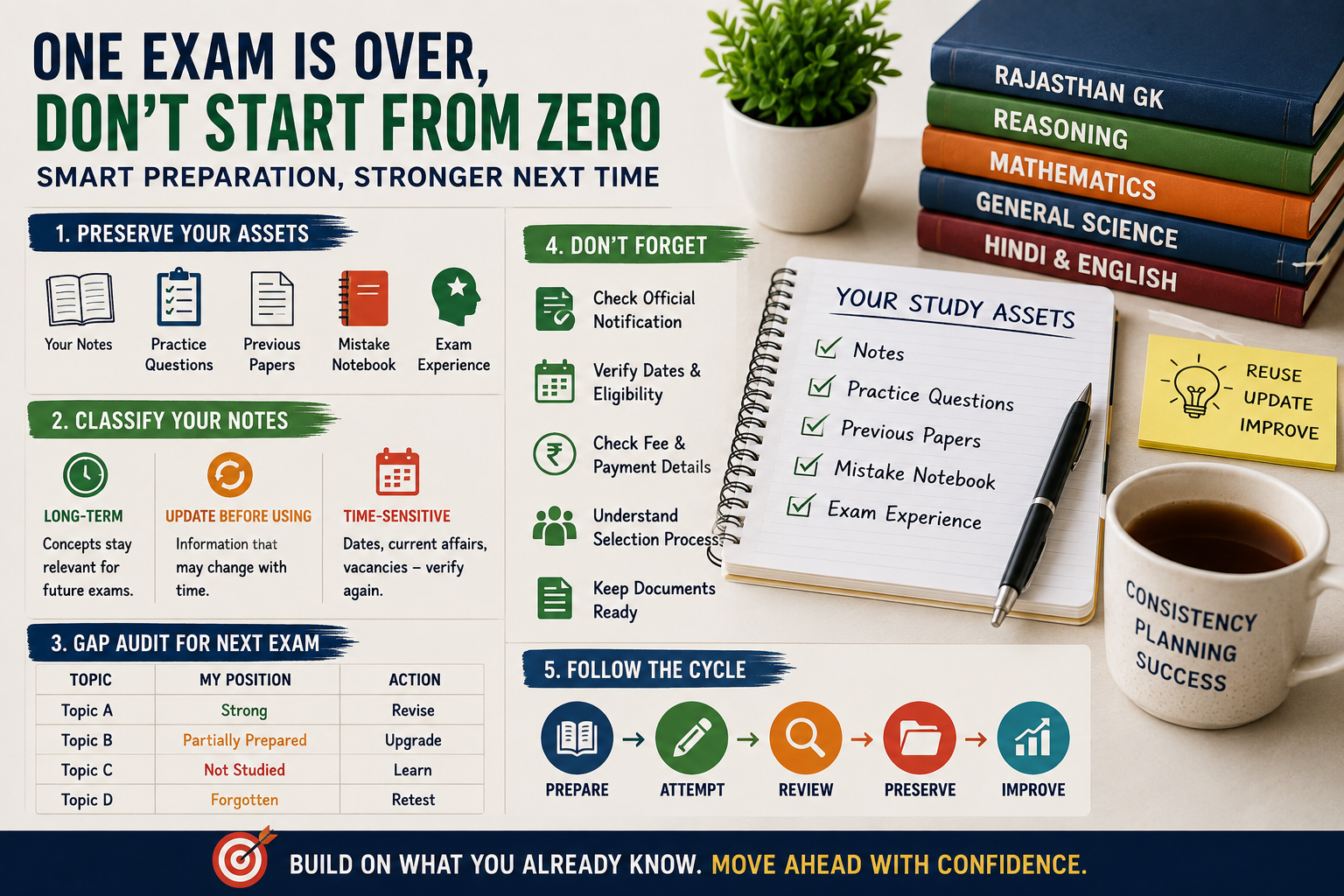
Give Your Notes an Expiry Label
Not all study information ages at the same speed.
This distinction is extremely important.
Consider three categories.
LONG-TERM
These are relatively stable concepts that may remain useful when relevant to another syllabus.
Examples might include basic mathematics methods, reasoning concepts or established historical and geographical knowledge.
UPDATE BEFORE USING
Some information remains useful but should be checked for changes.
For example, administrative information, certain statistics, institutional details or other facts that may be updated over time.
TIME-SENSITIVE
This category includes information such as:
- Current affairs
- Recruitment dates
- Vacancy numbers
- Application fees
- Current office holders
- Temporary government announcements
- Exam schedules
These should never be carried into a future recruitment cycle without fresh verification.
Simply writing L / U / T beside your notes can make future revision safer.
Conduct a 30-Minute Post-Exam Debrief
After an exam, students often remember exactly what happened.
A month later, much of that memory disappears.
Use that short window.
Don’t try to reconstruct every question.
Instead, write one page answering:
Which section felt easiest?
Where did I lose too much time?
Which topics surprised me?
What did I revise well?
Which preparation material was almost useless?
What would I change if I had another exam next month?
This isn’t about predicting your result.
It is about preserving the experience.
Your first real competitive exam can teach you things that twenty mock tests may not reveal—especially about pressure, concentration and time management.
Separate Your Library From Your Recruitment
Many aspirants organize folders like this:
CET 2026
LDC 2026
Exam XYZ
Inside each folder are repeated copies of mathematics, Rajasthan GK and reasoning notes.
Try a different system.
Create your permanent Preparation Library:
01 — Rajasthan GK
02 — Mathematics
03 — Reasoning
04 — Language
05 — General Science
06 — Computer
07 — Mistakes & Revision
Then create separate temporary folders for individual recruitments.
The permanent library stores reusable knowledge.
The temporary recruitment folder stores things such as:
notification, application confirmation, current syllabus, dates and exam-specific instructions.
Once the recruitment cycle is finished, you don’t need to keep temporary information mixed with your permanent knowledge.
When the Next Notification Arrives, Perform a Gap Audit
Suppose you prepared seriously for one Rajasthan examination.
A new recruitment is announced.
Don’t immediately begin Chapter 1.
First obtain the current official syllabus for the new examination.
Then compare it with what you already prepared.
Create three columns:
| New Exam Topic | My Current Position | Action |
|---|---|---|
| Topic A | Strong | Revise |
| Topic B | Partially prepared | Upgrade |
| Topic C | Not studied | Learn |
| Topic D | Previously studied but forgotten | Retest |
This changes the question from:
“How do I complete the whole syllabus?”
to:
“What is actually missing?”
That can make the next preparation cycle much more focused.
Test Old Knowledge Before Revising It
Don’t automatically reread everything because several weeks have passed.
Test yourself first.
Take a small set of appropriate questions or use blank-page recall.
If you still understand a topic well, it may need only light revision.
If you recognize the material but cannot retrieve answers, it needs recall practice.
If you have forgotten the concept itself, deeper revision may be necessary.
This is more efficient than treating every old chapter as equally weak.
Your memory should determine your revision priority—not the number of pages in the book.
Build a “Never Again” List
Your previous examination probably exposed mistakes you don’t want to repeat.
Perhaps you:
- Left revision too late
- Collected too many study resources
- Ignored one subject
- Spent excessive time making notes
- Started mock tests too late
- Struggled with question selection
- Relied on outdated information
Turn these into rules for the next cycle.
For example:
Never Again: Five Sources for One Subject
New rule:
Choose one primary source and add another only when there is a clear gap.
Or:
Never Again: Full syllabus first, mock tests later
New rule:
Introduce appropriate practice earlier in preparation.
The exact rules should come from your own experience.
Don’t Carry Old Recruitment Facts Into a New Exam
Reusable preparation has one danger:
outdated information can look familiar and therefore feel trustworthy.
Suppose your old notes mention an age rule, vacancy number, application fee or selection stage from a previous recruitment.
Never assume it applies to the new one.
For every new recruitment, verify current details including:
eligibility, dates, age conditions, syllabus, examination pattern, fees, vacancies and selection procedure through the relevant official notification.
Reuse your knowledge.
Do not blindly reuse old recruitment rules.
That distinction is essential.
Keep Your Mistake Notebook Alive
Your mistake notebook shouldn’t expire when an exam ends.
In fact, it can become more useful over time.
Suppose you repeatedly confuse two Rajasthan Geography facts across several months.
That tells you the problem is persistent.
If you repeatedly make percentage calculation errors, that’s also valuable information.
Keep recurring mistakes.
Remove or archive issues you have genuinely mastered.
Over several exam cycles, the notebook becomes a personalized record of weaknesses that generic preparation material cannot provide.
Measure Preparation by What You Retain
A student may say:
“I studied for six months for my previous exam.”
But the more useful question is:
What from those six months is still available to you?
If your notes are organized, concepts remain strong and mistakes are documented, those six months continue creating value.
If everything becomes scattered after the examination, much of that advantage disappears.
Your goal should be to make every serious preparation cycle strengthen the next one.
Final Takeaway
Competitive-exam preparation doesn’t need to operate as:
Notification → Study → Exam → Forget → Restart
A more sustainable cycle is:
Prepare → Attempt → Review → Preserve → Update → Reuse
When one Rajasthan examination finishes, preserve your useful notes, analyse your experience and separate stable knowledge from time-sensitive information.
Then, when the next legitimate opportunity arrives, compare its current official syllabus with what you already know.
You may discover that you aren’t standing at the beginning again.
You already have a foundation.
The next step is simply to determine what can be reused, what needs updating and what genuinely needs to be learned from scratch.
FAQs
Can I use my old notes for another Rajasthan competitive exam?
Yes, when the relevant concepts overlap, but compare them with the current official syllabus and update any information that may have changed.
Should I keep current-affairs notes after an exam?
You can archive them for reference, but time-sensitive information should be freshly verified before being used for a future examination.
Do I need new books for every government exam?
Not automatically. First identify what the new syllabus requires and whether your existing resources adequately cover the relevant topics.
How should I start preparing when a new recruitment is announced?
First verify the official notification and syllabus. Then compare the syllabus with your existing preparation and identify topics to revise, upgrade or learn.
Can I reuse an old recruitment’s eligibility and exam-pattern information?
No. Recruitment rules can change between cycles. Verify eligibility, dates, fees, exam pattern and selection requirements from the current official recruitment information.